
By Matthew Busch
At sixty-six, Darrell Scott is still creating in constant motion.
We spoke with Scott ahead of his show at The Rialto in Raleigh. The conversation ranged from working-class roots to songwriting craft to the value of handmade art. Below are highlights from that discussion. If you’re reading this ahead the show, grab a ticket here. An evening with Scott isn’t just a concert — it’s vivid storytelling.
New Songs, Old Soul
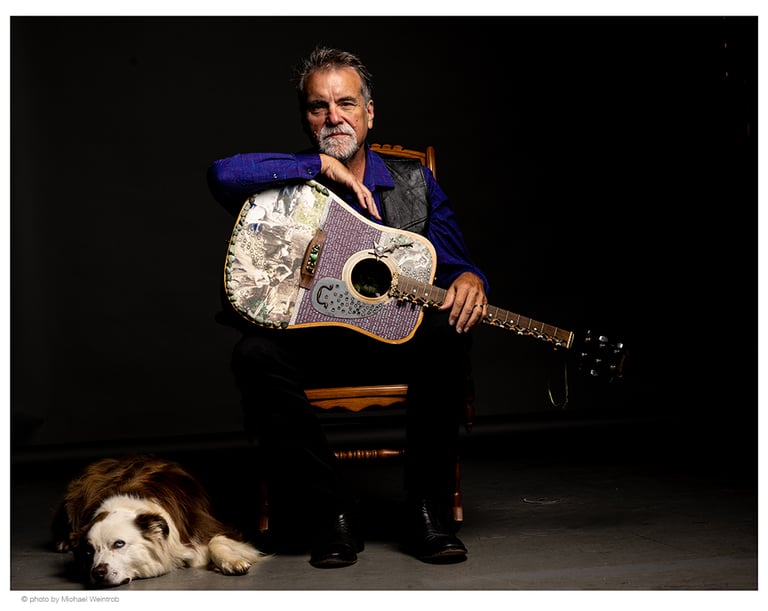
Scott recently performed with Rob Ickes for a live broadcast at WMOT in Nashville. The set featured new material — and a new guitar. One song in particular, “I’ll See You There,” co-written with Marcus Hummon, stood out.
The song took years to complete.
“It had enough beauty in it that it didn’t make sense to finish it off in some haggard way,” Scott said.
For Scott, patience is part of the craft.
A quick sidenote for his music lovers: Every new moon, Darrell hosts a show called “New Moon, New Music” on his website, where he shares newly written songs along with the stories behind them, coupled with journaled reflections. So tune in here.
Writing the Working Class
Much of Scott’s catalog centers on working people and lived experience.
RML: As a songwriter who has always written about working people, is that a central muse for you?
Scott: “Yeah, definitely. It’s not my only muse, but I come from the working class. My mom and dad were tobacco farmers in Kentucky during the Depression. Their big chance to get away was to go work in factories up north. I have that same muse for the working musician. I grew up playing in bars — but also on Sunday mornings in churches.”
For Scott, songwriting isn’t about charts — it’s about truth.
“I keep my eye not on how high someone gets in the charts, but how good a song they make. I don’t need something in the Top Ten for me to notice it. As a matter of fact, I probably won’t notice it — I’m not listening to the Top Ten. I’m listening for great songs from someone telling the truth.”
And he doesn’t wait for those songs to find him. Scott teaches songwriting workshops across the country.
“I really want people to write about what’s important to them. It has nothing to do with the charts or any of that silly stuff.”
As a teacher myself, that resonated deeply. There’s something powerful about being present while someone develops a craft — especially when they aren’t yet widely known. The process matters more than the applause.
Growing Up Invisible
I often ask musicians whether they had a teacher in the classroom who made an impact during their elementary through high school years. Scott’s answer was simple but telling: not really.
His parents moved frequently in search of work, and he was often the new kid in school.
“When I went to public school, I was trying to be invisible. There were a few reasons for that. I was always the new kid, and I have a natural tendency to be shy.”
At sixteen, he left high school in California after passing the California proficiency exam, earning his diploma by the summer of his junior year.
Seven years later, after a marriage, a divorce, time in Canada, and years playing in bands, Scott enrolled in community college near Boston. At twenty-three, he decided to focus. That’s when professors began noticing him.
“When I began to show up as a student who cared, that’s when I got the attention of professors. They’d reach out during office hours. I still have professors from 1983 that I’m in contact with.”
Reverence for Craft
Earlier this month, we spoke with Peter Rowan about his love of handmade objects collected while touring. Noticing Scott’s handmade jewelry onstage, we asked if he felt the same reverence.
RML: As you travel, do you feel a connection to handmade crafts?
Scott: “Absolutely.”
He pointed out the irony of festival culture:
“I get paid to be there. Those people — who are also artists — have to pay for a booth at the same festival. I’ve seen that irony my whole career. So I make sure I get out there and see their stuff — because I want to see it. And I’m definitely going to be sharing some money. My house shows that.”
Scott described pottery, instruments, and artwork collected over decades. His wife, who once ran a mixed-arts gallery in Nebraska, shares the passion.
“You put the two of us together at a festival, and if we see something we want — it’s on. We’re coming back with it.”
Literal Truth vs. the Intangible
Some of Scott’s songs, like “There Ain’t No Easy Way,” wrestle with difficult-to-define emotional terrain. I asked, basically, whether abstraction ever serves as a muse.
DS: “I find that I’m very linear and literal. Take ‘You’ll Never Leave Harlan Alive.’ It’s so literal that I’ve had people send me their family genealogy based on the song. So that’s accuracy. That’s almost journalism. And I have a lot of linear songs, and in a general way, that’s the way country music is. It’s very literal.”
“It’s the music of working people. Working people aren’t flying twenty feet off the ground in metaphor. They’re speaking in their vernacular. So I write in that linear way a lot of the time. But when a song comes along that’s more vague — where you don’t know precisely what it means — I love that too, because I’m so linear.”
Closing Thought:
At this stage of his career, Darrell Scott isn’t chasing relevance. He’s chasing resonance.
The charts don’t guide him. Truth does, and if you're looking forward to the year ahead and checking Scott out here you go, Scott is touring at a number of awesome venues, including one last stop in NC at the Grey Eagle in Asheville.
But if you’re in Raleigh Thursday, that truth will be coming through a wooden guitar on a small stage — told plainly, beautifully, and without haggard endings.